When planning your pre-engineered steel building, the very first step is establishing the right size for your structure – this ensures that you will have a perfect fit – not only for your immediate needs, but also for years to come. Whether you are designing a spacious warehouse, a versatile garage, or a personalized workshop, accurate measurements are essential to maximize your usable space.
Understanding key elements related to exterior measurements and how they differ from actual interior clearance, will allow you to make informed choices and confidently start your building project. With the flexibility of steel and clear-span design, you are not just building a structure but creating a space that can evolve with your requirements over time.
Let us dive into important key terms to ensure your building meets your vision.
Understanding the Walls of Your Steel Building
Before diving into the measurements, it is essential to grasp the roles of the building’s walls. Steel buildings typically feature two main types of walls:
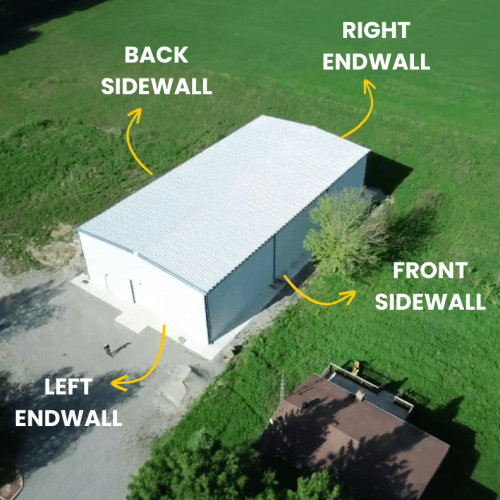
- Endwalls: These walls are easily identified because they form the building’s peak, meeting the roof at an angle. The endwalls are defined by a rising line where the roof meets the wall, providing additional height to the walls. We sometimes refer to this wall as the gable wall and although the endwalls are referred to as either the left or right endwalls, they are typically defined by the front entrance of the building.
- Sidewalls: These are the flat walls that run along the length of the building, where the roof meets the walls in a line parallel to the ground without any increase in height.
Defining Out-to-Out Measurements
Now that we understand the walls, let us talk about how to measure the size of your building. The out-to-out measurement is the method used for determining the overall exterior dimensions of a steel building. This method refers to the distance from the outermost points of the building’s structure, including the walls, measured from edge to edge.
Specifically, the out-to-out measurement includes:
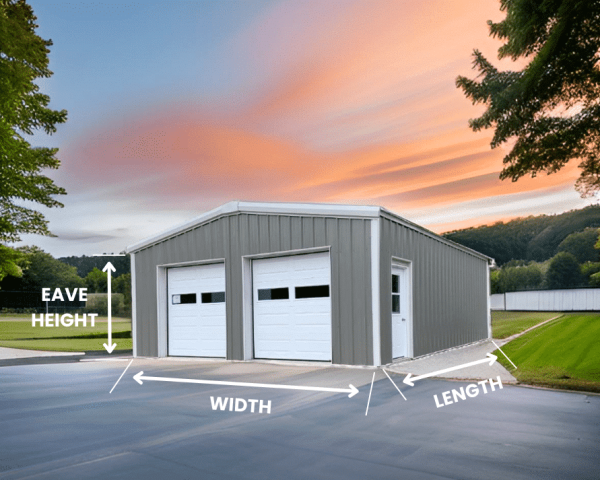
- Width: The distance from one sidewall to the other, measured along the outer edges. Technically speaking we measure the width from the outside of the sidewall girt on the back sidewall, to the outside of the girt on the front sidewall.
- Length: The total length of the building, from the edge of one endwall to the edge of the other endwall. In other words, the length is the distance from the outside girt on the left endwall, to the outside girt on the right endwall.
- Eave Height: The height of a metal building system is measured to the eave – not to be confused with the height at the peak of the building. Specifically, the height is the measured distance from the finished floor to the point where the roof meets the wall.
Interior Clearance: Defining Your Usable Space
One of the greatest advantages of Clear-Span Framing in pre-engineered steel buildings is the ability to have 100% usable interior space. This design eliminates the need for intermediary columns or support, giving you an open, unobstructed area to work with.
Interior clearance refers to the usable area inside the building, which is the difference between the exterior out-to-out measurement and the portion occupied by the frame and walls. It represents the clear-span space, factoring in the framing of the building.
The drawing below illustrates this difference in measurements. In this example, the external out-to-out width of the building is 24’, while the interior clearance width, highlighted in yellow, measures 21’-4’’.

Pro Tip: Plan for Extra Space
Why Getting These Measurements Right Matters
Taking the time to properly understand and plan for both exterior dimensions and interior clearance is an essential step to getting the most out of your steel building. A well-fitted structure enhances functionality, prevents future expansion challenges, and ensures the building serves your purposes for decades.
Knowing these terms and measurements from the outset helps ensure alignment with your building consultant, making the design and construction process run smoothly. This clarity allows for effective communication keeping your project on track and within budget.
Remember, your steel building is an investment. Getting the dimensions right from the start helps you avoid unnecessary costs down the line. Clear-span designs offer flexibility and freedom to tailor the space to your needs, whether you’re looking for a spacious warehouse, a personalized workshop, or anything in between.